
Reviewer 1 vs. Reviewer 2: Whose Opinion Carries More Weight?
Updated: 2 days ago
An early(ish)-career editor’s perspective
By Sonali Roy
Disclaimer: The views expressed here are my own and do not represent those of any journal, society, or publisher.
Reviewer 1 thinks the manuscript is exciting, timely, and should be published after a few minor revisions.
Reviewer 2 has produced a formidable list of concerns, wants several new experiments, and is considerably less enthusiastic.
So, whose opinion carries more weight?
The answer is perhaps less satisfying than choosing Reviewer 1 or Reviewer 2: peer review is not a vote (Seth S Leopold, 2014).
After a few years of handling manuscripts, I have come to appreciate that the harshest reviewer is not necessarily the best reviewer. Neither is the most enthusiastic one. Even being timely is not the greatest mark of a good reviewer! (Although, from an editor's POV who is trying to make timely decisions for authors, it really, really helps.)
What matters much more is whether a reviewer helps me, as the handling editor, understand the manuscript better.
What does an editor actually need from a reviewer?
Handling editors are generally familiar with the broader scientific area of a manuscript, but we are not always experts in its particular niche. A good reviewer therefore does something much more useful than simply deliver a verdict.
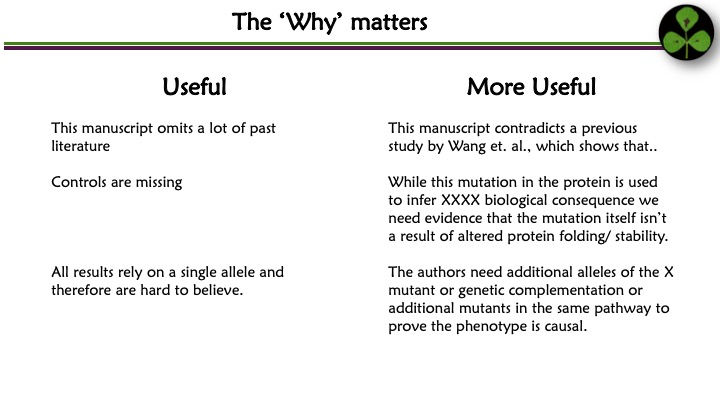
(1) They explain the 'Why' behind their criticism/praise
The reviews I find most valuable explain the reasoning behind a criticism, rather than the criticism itself. If an experiment is flawed, why is it flawed? If an interpretation is not sufficiently supported, where does the logic break down? And, importantly, which of these problems actually matter for the conclusions of the paper?
The best reviewers are also willing to remain part of the conversation. They participate in post-review discussions when reviewers disagree, respond when I have a question about one of their comments, and help me determine whether a concern is essential to resolving the central scientific issue.
(2) If they ask for experiments, they are usually controls (rather than exploratory ones).
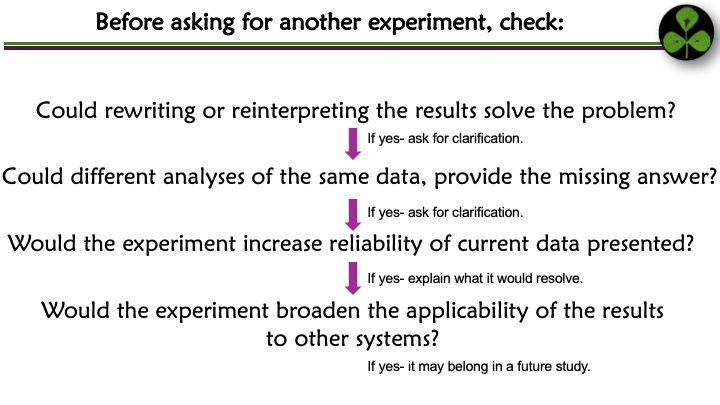
There is a difference between identifying an experiment needed to support a central conclusion and proposing an interesting experiment that would expand the paper into new territory. Good reviewers tend to recognize that distinction. They criticize individual experiments where appropriate and may suggest additional controls, but they do not ask authors to substantially broaden the scope of the study simply because another direction would be interesting.
Importantly, every additional experiment comes at a cost—not only in reagents and researcher time, but also in the publication timeline. When considering reviewer requests, I therefore ask, which concerns could instead be addressed using existing data or careful additional analyses? If the manuscript would require so many new experiments that revision effectively becomes a new research project, rejection may be the fairer decision. It does authors a disservice to hold a manuscript for months when another journal may be willing to publish the study in its current form.
(3) They stay with the manuscript through successive rounds of review
Ideally, reviewers also stay with a manuscript through revision.
This is not always possible, I understand as a reviewer myself, but when additional review is required, a reviewer who raised a concern is often better placed to determine whether the authors have resolved it, and continuity can prevent authors from receiving an entirely new set of requests from someone reading the manuscript for the first time.
And what makes a review less useful?
Interestingly, the least useful reviews I have encountered tend to have something in common: they feel rushed.
Some reviewers comment almost exclusively on the figures. I find it difficult to trust such a review because it gives me no indication that they read the manuscript’s central idea, methods, results, or discussion. Others provide only a sentence or two summarizing an overall impression of the paper. Editors have already done this and discussed the manuscript’s broad fit and potential significance before sending it for external review. What I need from a reviewer is the expertise that I do not already have.
In my editorial experience so far, I have fortunately not encountered the overtly rude or hostile reviews that authors sometimes describe. If I do encounter one, I would make it clear during the post-review discussion that I will not be sending those comments to the authors.
What is the role of the editor?
My role as an editor is not simply to count recommendations. It is to synthesize the concerns into clear, addressable tasks that would meet journal standards as well as reviewer concerns.
I read the full reviews and look for common themes. Two reviewers may phrase their concerns very differently but nevertheless be pointing toward the same weakness. These are the points that I pay extra attention to and eventually highlight in the decision letter.
I also read the manuscript itself so that I can evaluate the merits of the reviews against the data and arguments the authors actually present. Admittedly, this is not necessary, and it slows me down when making decisions. But it also means that when I ask authors to undertake substantial revisions or decide that a particular reviewer request is unnecessary, I know what I am talking about (!!).
So whose opinion carries more weight?
For me, it is the reviewer who communicates the reasoning behind their concerns clearly.
It matters whether I can understand why a reviewer thinks a particular weakness affects the conclusions and what would be required to address it.
This is also why peer review cannot simply be a vote. Reviewers bring different expertise to a manuscript and will inevitably notice different things. The editor's job is to use that expertise to determine which concerns are scientifically important and which requests go beyond what is necessary to support the central conclusions.
Author’s note: This post was edited for grammar and flow with assistance from artificial intelligence (AI). All experiences, observations, and ideas are the author’s own.


Comments