
THE ROY LAB
Outreach
This page features our outreach activities, including workshops, public engagement efforts, and shared educational resources. Materials developed are made available for reuse to support broader participation and learning in plant science.
A Pyramid Model of Engagement
Outreach approached as a continuum

We think of outreach as a tiered pyramid that begins with personalized mentoring and training in the lab and scales outward through teaching, workshops, and community engagement. Core trainees form the apex of this model, disseminating knowledge through classrooms and educator training, while new initiatives aim to connect lab members with professional networks.
If you would like to contribute to or partner with us at any level of this outreach pyramid,
we would love to hear from you.
04.
Building Teaching Capacity in CRISPR and Genome Editing

This activity represents professional outreach focused on broadening access to and building sustainable teaching pipelines in genome editing technologies.
Event type: Intensive faculty/teacher training workshop
Date: July 7–11, 2025
Location: Whitehead Institute, Massachusetts Institute of Technology (MIT), Cambridge, Massachusetts
Organizers: Sonali Roy (Tennessee State University), Maxine Wang and Masami Hazu (Jonathan Weissman Lab, Whitehead Institute), Mandana Sassanfar (Massachusetts Institute of Technology)
Audience: Faculty instructors from Historically Black Colleges and Universities (11) and K-12 educators in Massachusetts (7) involved in teaching CRISPR, genomics, and plant biotechnology.
Gap Addressed: Agricultural biotechnology is a major and rapidly growing sector, requiring a skilled workforce trained in CRISPR and genome editing. Despite strong industry demand and student interest, access to dedicated, hands-on plant biology-focused CRISPR instruction remains limited, particularly at 1890 land-grant HBCUs.
Impact: The workshop provided participating educators with hands-on CRISPR training, ready-to-adapt laboratory modules, and guidance on curriculum design. Pre- and post-workshop surveys (Figure below) showed substantial increases in self-reported comfort across core areas, including CRISPR course design, guide RNA design, and communication of complex scientific ideas. Survey and interview data identified immersive laboratory training, structured curriculum development, and peer exchange as the most impactful components of the workshop.

Dumbbell chart illustrating change in self-reported comfort levels among faculty participants of the CRISPR Course Workshop using retrospective ratings of 0 (None or extremely little comfort) to 4 (Very high amount of comfort) before (⚫) and after (⚫). The grey ◼ are used to indicate level of familiarity using a scale of 0 (Not familiar) and 4 (Extremely familiar) for 7 participants who completed a pre-survey. Data collected by RTRES Consulting, Knoxville.
This 'teach-the-teacher' workshop aimed to broaden access to CRISPR education and strengthen the teaching workforce by supporting instructors in developing and implementing hands-on genome editing curricula at their home institutions.
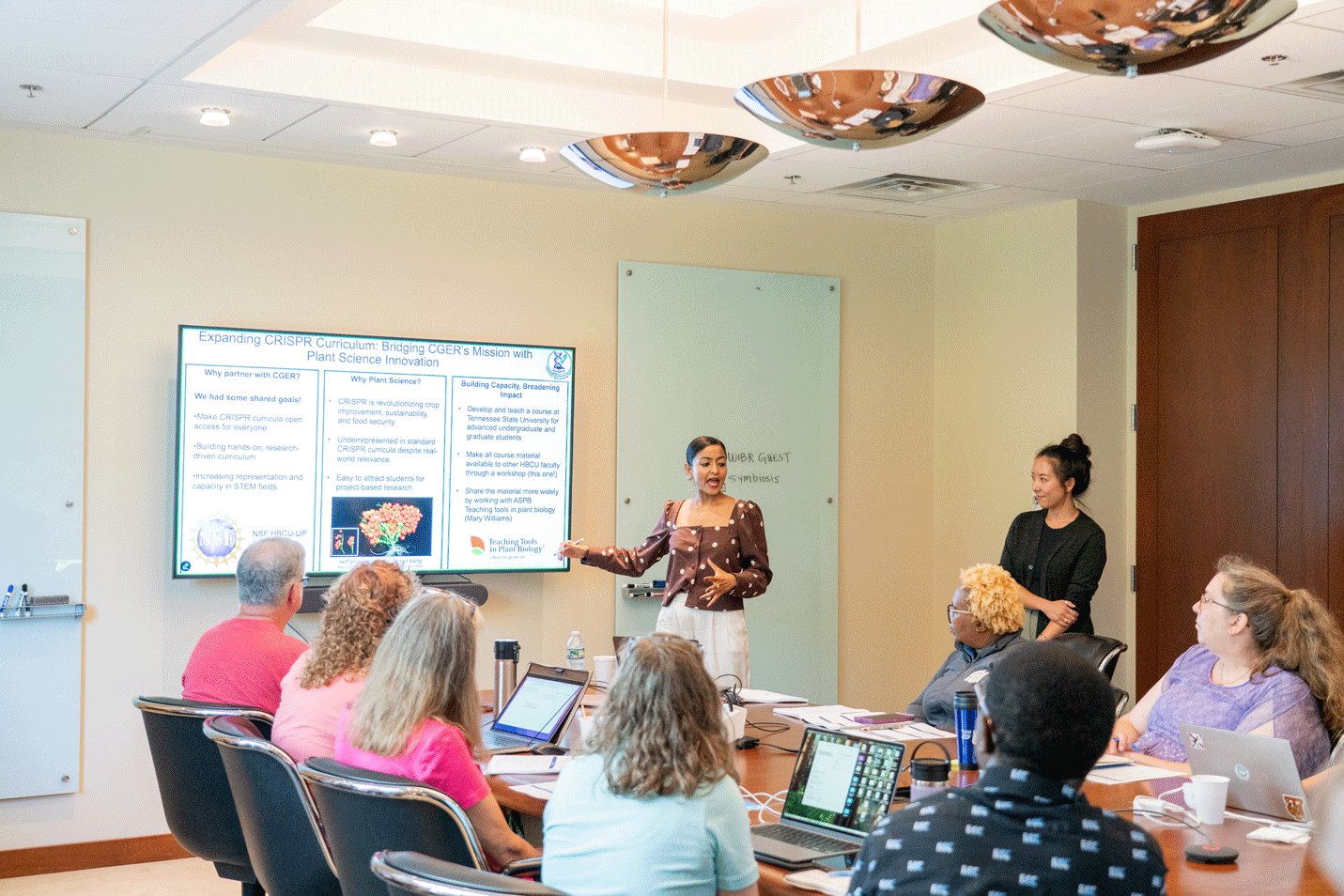
A 5-day instructor training workshop held at the Whitehead Institute
Reflections and Lessons Learned
-
Curriculum Development: The majority of faculty members expressed a strong desire to either integrate CRISPR into existing courses or create new, dedicated elective courses. They often cited the need for a lengthy approval process, particularly at state institutions, as a barrier to implementation.
-
Resource Constraints: A significant and recurring barrier was the lack of financial resources for equipment, kits, and supplies. Several faculty members emphasized the need for funding to purchase CRISPR kits, which can be expensive.
-
Technology Adoption: There was a mixed use of lab notebooks. While some faculty still relied on traditional paper notebooks, many recognized the value of electronic notebooks like Benchling for real-time data recording and improved data management in molecular biology.
Data were collected by RTRES Consulting, Knoxville.
We gratefully acknowledge support from The National Science Foundation to Sonali Roy (2205542), The National Institute of Health to the Weissman Lab and the Masschussett's Institue of Technology
03.
Are legumes the poor man's meat?
Nashville - A case study.
This activity represents public-facing outreach that examines misconceptions about legumes in modern American diets through systematic documentation.
Activity type: Systematic documentation
Date: October 2023 - present, Ongoing
Location: Nashville
Researcher: Sonali Roy (Tennessee State University)
Audience: General public, students, educators, and scientists interested in food systems, legume diversity, and plant-based diets.
Gap Addressed: Despite the central role of legumes in sustainable food systems, their use in modern American diets is often discussed through simplified or outdated narratives. This project addresses the lack of systematic documentation of legume diversity within contemporary food contexts.
Impact: This outreach effort contributes to scholarly and public discussion on legume diversity and cultural perceptions of plant-based protein. Preliminary observations from this work were presented as part of "The Art and Science of Harnessing Legume Diversity" talk during the American Society of Plant Biologists' (ASPB) Centennial Presidential Plenary, providing an opportunity to engage a broad scientific audience in re-examining narratives surrounding legumes in modern American diets.
02.
Building Inclusive Scientific Communities Through Networking and Dialogue
This activity represents community-building within professional outreach, focused on fostering connection and sustained participation in plant-microbe research.
Event type: Conference social networking event; IS-MPMI Diversity, Equity, and Inclusion Social
Date: July 18, 2023
Location: International Society of Molecular Plant–Microbe Interactions (IS-MPMI) Meeting, Providence, Rhode Island
Organizers: Sonali Roy (Tennessee State University) and Edel Perez-Lopez (Université Laval)
Audience: All conference attendees, scientists, trainees, and professionals attending the IS-MPMI meeting, including individuals from LGBTQIA+, Black, Latinx, Indigenous, and immigrant communities, as well as allies.
Gap Addressed: Opportunities for informal networking and community-building for scientists from underrepresented backgrounds are often limited at large scientific meetings, despite their importance for fostering belonging, peer support, and long-term participation in STEM. Structured spaces for open dialogue around identity, inclusion, and shared experiences are rarely integrated into conference programming.
Impact: The event created a welcoming, low-pressure space for connection and dialogue among scientists from diverse backgrounds and career stages. By facilitating peer interaction and visibility within a major international meeting, this effort contributed to strengthening inclusive professional networks that support sustained participation in plant-microbe research.
Participants engaged in small-group conversations facilitated by discussion leaders on topics including challenges and opportunities for LGBTQIA+ individuals in STEM, experiences of Black, Latinx, and Indigenous scientists, and cultural assimilation as an immigrant in science.

Group discussions at the outdoor networking event
The session format included:
-
Facilitated small-group discussions on identity, inclusion, and professional experiences
-
Informal networking and peer connection in a relaxed, social setting
-
Open participation for both community members and allies
We gratefully acknowledge support from a small grant from the American Association for the Advancement of Science (AAAS) to host this event.
01.
Increasing the Visibility of Undergraduate Researchers and Their Mentors to Support STEM Retention
This activity represents professional outreach focused on broadening participation, mentorship, and workforce development in plant-microbe research.
Event type: Conference workshop & networking session; Concurrent session: Showcasing Undergraduate Research and Mentoring in Plant–Microbe Interactions
Date: July 2023
Location: International Society of Molecular Plant–Microbe Interactions (IS-MPMI) Meeting, Providence, Rhode Island
Organizers: Sonali Roy (Tennessee State University) and Liana Burghardt (Pennsylvania State University)
Audience: Undergraduate researchers in plant–microbe interactions, early-career mentors (graduate students and postdoctoral researchers), and the broader IS-MPMI scientific community.
Gap Addressed: Undergraduate researchers often make substantial contributions to scientific discovery but have limited opportunities to present their work in professional settings. At the same time, the intensive mentorship provided by graduate students and postdoctoral researchers is rarely recognized in formal scientific forums. This workshop was designed to highlight the importance of mentor–mentee partnerships and to create a platform where undergraduate research and mentorship could be showcased together.
Impact: The session provided undergraduate researchers with a visible platform at an international meeting, strengthened their networks, and a 2-year follow-up with undergraduate speakers (from PUI, HBCU, non-R1 universities) showed 100% retention in the graduate training pipeline in plant and microbial sciences.
This session introduced a mentor–mentee co-presentation model, in which undergraduate researchers and their early-career mentors jointly presented research findings in molecular plant–microbe interactions, spanning disease, symbiosis, and bacterial and fungal interactions.

Panel discussion featuring mentor-mentee pairs
The session format included three parts:
-
Team-presented research talks, with at least half of each presentation delivered by the undergraduate researcher. (15 minutes x 4 talks + Questions)
-
A moderated panel discussion on effective mentoring strategies and productive research partnerships. (30 minutes)
-
A one-hour speed-networking session focused on career exploration for undergraduate researchers featuring themed tables on: Industry careers, Government and policy, Graduate school and international Ph.D. programs, Scientific societies and foundations, Graduate student and postdoctoral perspectives. (30 minutes)
We gratefully acknowledge support from a small grant from the New Phytologist Trust for student networking activities. A full list of participants is available here.
Other Outreach Events
These activities represent public-facing outreach about technology-derived foods in partnership with the College of Agriculture at Tennessee State University.
Activity type: Public science outreach
Date: Various times each year
Location: Tennessee State Fair, 4-H / FFA Agriculture Pavilion, Lebanon, Tennessee, Small farmer Expo at the TSU farms, TSU Summer Apprenticeship Program
Organizer: TSU College of Agriculture outreach team
Audience: General public, families, K–12 students, educators, and community members attending the Tennessee State Fair, with a focus on audiences interested in agriculture, food systems, and biotechnology.
Gap Addressed: Public understanding of CRISPR and genome-edited foods is limited and often shaped by misconceptions, with few opportunities for informal, face-to-face conversations that connect biotechnology to everyday food and agriculture.
Reach out to us for classroom visits across Nashville!

High school students are introduced to fundamental molecular science techniques in our lab at the College of Agriculture, TSU.
