
That’ll do, pig: Using CRISPR to change the porcine-ality of agriculture and medicine
By Samantha Fann
Have you ever compared someone to a pig as an insult? Well, while calling someone a pig is considered rude, you might have said a fun fact without realizing it. Humans are genetically, anatomically, and physiologically very similar to pigs. So much so that they are a perfect model for studying the mechanisms of human disease. Our lives are so intertwined with pigs that not only are they an economic staple in agriculture but also biomedicine, emphasizing the incentive to maintain stability in the industry.
Pigs account for 35% of total global meat production (1). With the global demand for pork increasing, movement of swine and multiple contact points with humans give several ‘porcine’ (related to pig) viruses more opportunities for transmission and mutation (2). There are several viruses that cause severe economic losses to the swine industry (3). For instance, African Swine Fever Virus (ASFV), a virus that targets blood vessels, spreads super easily through waste and secretions (things pigs are NEVER low on) and all it takes is a tiny bit getting in a shipping container headed to Portugal to cause an outbreak with a 100% mortality rate, as seen in the 1957 ASFV outbreak in Lisbon.

Meet CRISPR - Nature's Gene Editor
If you can’t stop viruses from existing, the next best thing is developing a way to protect the animal from infection by blocking the virus from replicating (4). If you make swine resistant to viruses, it will not only help economically, it will also minimize the risk of viruses mutating and potentially infecting humans. These ideas are made possible by a breakthrough in technology called CRISPR.
So what is CRISPR (and WHY has nobody in academia acknowledged the humor that CRISPR sounds like ‘crisper’ especially when applying it to the animal that gives us bacon?!)? CRISPR (Clustered Regularly Interspaced Short Palindromic Repeats) is a bacterial immune response to invading bacteriophages.
You know how we’re told there are millions of bacterial cells taking up a dot of space at any given time? Well, there’s ten times as many viruses that infect them called phages. They look like cute little robot spiders, but they are hijackers. The phage injects its DNA inside the bacterium to hack its system to turn it into a phage factory to make a bunch of new phages. Eventually, so many phages are made that it makes the bacterium burst, releasing all those phages into the world to continue the cycle.
The bacteria needed to evolve a way to defend themselves. In comes CRISPR-Cas systems!

These palindromes serve as recognition sequences and Cas protein acts as molecular scissors that sequences for Cas cleave DNA (Innovative Genomics)
The bacteria take small pieces of DNA from the invading phage and stores it in its own genome as a memory. Imagine a bounty hunter keeping a mugshot of a wanted person in their pocket. These mugshots are stored in between short repeated sequences read the same backwards and forwards called palindromes. The bacterium uses these CRISPR sequences to produce a RNA that will guide a protein called Cas to the target DNA. The bacteria compare the DNA in the invading phage to the mugshots it has stored in its DNA and when there’s a match, the Cas protein acts as molecular scissors that cleave the DNA and destroy the phage. We found the coolest way to exploit this!
CRISPR-Cas systems can be programmed using specific guide RNAs that act as the mugshots to precisely target, cleave, and edit any gene of interest in animals and plants. Instead of selectively breeding for desirable traits like disease resistance, which can take YEARS and often comes with inbreeding, we can use CRISPR to directly manipulate a gene to add, remove, or modify expression.
Less than a year ago, for the first time, a specific CRISPR-Cas9 multiplexed guide RNA system (meaning multiple guide RNAs instead of just one, allowing more sequence specific cleavage) was made to target regions of the ASFV genome, resulting in the first CRISPR-based therapeutic for ASFV shown to be effective in swine!
Testing a CRISPR therapy
Pharmaceutical research scientists at Seek Labs in Salt Lake City, Utah designed multiple guide RNAs to target ASFV strains currently circulating in a pandemic in Eurasia. The pathogenic ASFV agent was isolated from an infected spleen in a pig that tested positive for the virus and exhibited severe clinical symptoms (bleeding, fever). Specifically, they targeted G1211R, a gene involved in initiating viral replication.
After growing host cells in media and designing guide RNAs, they needed a plasmid cloning vector: think of it as the vehicle in which we transfer the genetic material into host cells where it can then be replicated. As the host cell divides, the foreign DNA is amplified.
They utilized a single expression plasmid to deliver both guide RNAs and Cas9 in what is called a SL_1.52 therapeutic (5).
Did it work?
The group designed their experiment as follows:
Fourteen pigs were randomly selected, divided into two groups (treatment vs. control) and housed in separate pens. Before starting, they tested all the pigs to make sure they tested negative for previous and current infection of the virus.
In both groups, pigs were injected intramuscularly with a lethal dose of the virus.
Five days post-infection, the treatment group was given the SL_1.52 therapeutic.
Symptoms, behavior, gait, and temperatures of all of the pigs were recorded daily.
Every 5 days, blood samples were taken from all of the pigs and tested for presence of ASFV using real-time PCR (a way to measure the exact amount of the virus present).
After 10 days post-infection (dpi), there was a statistically lower viral load in all of the treated animals. As seen in the figure below, by 35 dpi, 4 of the 7 pigs in the treated group survived and were able to clear the virus to undetectable levels, which is amazing since this virus usually has a near 100% mortality rate!
To determine if the SL_1.52 therapeutic facilitated an immune response to protect against future infections, the surviving animals were given a second lethal dose of ASFV, also administered intramuscularly. All pigs that had previously recovered from the virus with the new therapeutic survived the second lethal dose!
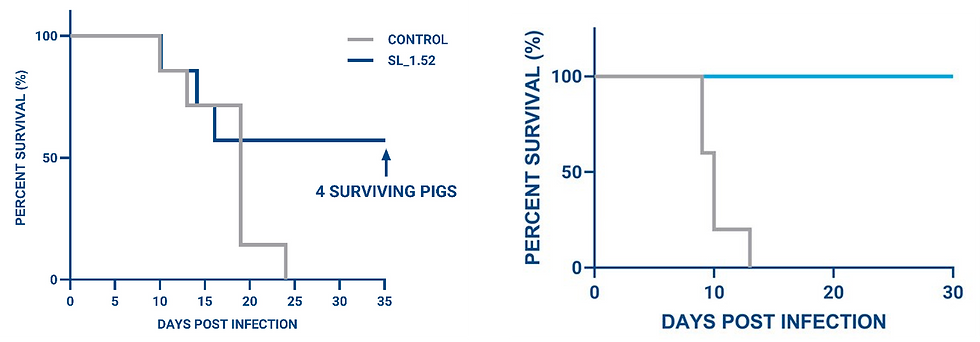
Overall survival of animals infected with the lethal dose of ASFV followed by the SL_1.52 therapeutic compared to the control animals over a period of 35 days
Evaluation of immunity to a second lethal dose of ASFV in pigs surviving the first infection and treatment (in blue) compared to the control (in grey) Verma et al. (2025).
This marks the successful application of CRISPR-Cas9 effective against ASFV. Not only did 57% of pigs survive the lethal dose and clear the virus to undetectable levels in 35 days, after a second lethal dose of the virus the pigs developed a major immune response and survived that too!
Looking Ahead
This is only the beginning, and as a student of genetics, I can’t wait to read more studies. I would like to see the effectiveness of SL_1.52 under conditions of an active field pandemic. I also would be interested in more studies using additional guide RNAs targeting more sites of the ASFV genome, as well as the genome of other economically important swine viruses. It is easy to dream about this while living in the United States of America. In many countries in Africa and Asia, farmers are completely dependent on trade with other countries. There are no buyouts for farmers if an outbreak occurs. I ultimately hope for this technology to become accessible to the more vulnerable parts of our world, because their livelihoods are just as vital to the economy and public health. When we all have the tools, we can truly work together and make improvements on a bigger scale.
On a more personal note: I remember in 2009 when the H1N1 swine influenza virus (SIV) outbreak happened in my hometown in Tennessee. Pigs were culled and the industry of course took a hit, but this virus also took the lives of humans too. I could not help but wonder if and how this could have been implemented to that scenario.
Additionally, with pigs being so similar to us, wouldn’t it be interesting if we could use CRISPR-Cas9 to genetically engineer pigs that mimic human disorders to study the effects of treatments before moving to human trials? The possibilities of CRISPR-Cas9 are endless! It goes beyond agriculture for humans, but in my opinion agriculture is the perfect place to start.
References
Fu, B., Ma, H., Huo, X., Zhu, Y., & Liu, D. (2024). CRISPR technology acts as a dual-purpose tool in pig breeding: Enhancing both agricultural productivity and biomedical applications. Biomolecules, 14(11). Retrieved from https://doi.org/10.3390/biom14111409
Glud, H. A., George, S., Skovgaard, K., & Larsen, L. E. (2021). Zoonotic and reverse zoonotic transmission of viruses between humans and pigs. APMIS, 129(12), 675–693. Retrieved from https://doi.org/10.1111/apm.13178
Islam, M. A., Rony, S. A., Rahman, M. B., Cinar, M. U., Villena, J., Uddin, M. J., & Kitazawa, H. (2020). Improvement of disease resistance in livestock: Application of immunogenomics and CRISPR/Cas9 technology. Animals, 10(12), 1–20. Retrieved from https://doi.org/10.3390/ani10122236
Verma, N., O'Mahony, A., Mohammad, R., Keiser, D., Mosman, C. W., Holden, D., Starr, K., Bauer, J., Bauer, B., Suntisukwattana, R., Atthaapa, W., Tantituvanont, A., Nilubol, D., & Gladue, D. P. (2025). The first CRISPR-based therapeutic (SL_1.52) for African swine fever is effective in swine. Viruses, 17(11). Retrieved from https://doi.org/10.3390/v17111504
Yuan, H., Yang, L., Zhang, Y., Xiao, W., Wang, Z., Tang, X., Ouyang, H., & Pang, D. (2022). Current status of genetically modified pigs that are resistant to virus infection. Viruses, 14(2). Retrieved from https://doi.org/10.3390/v14020417
Zhang, X., Zhao, X., Song, Y., Luo, Y., Yao, L., Wu, Q., Ye, T., Liang, W., Zhang, X., Liang, Y., Liang, B., Zhang, J., & Li, X. (2026). Advances in CRISPR-Cas12a/13a-based nucleic acid detection for porcine viral diseases: A comprehensive review. Veterinary Sciences, 13(2). Retrieved from https://doi.org/10.3390/vetsci13020141

Samantha Fann is a Master's student in Agricultural Sciences at Tennessee State University, specializing in insect biology and management. Her research focuses on fire ant monitoring and control in the state of Tennessee.


Comments