
The two Times “I Have a PhD in Plant Biology” Wasn't Quite the Flex I Imagined
Updated: 18 minutes ago
By Sonali Roy
Most people think I know a thing or two about plants when they find out I have a PhD in Plant Biology (Legume Molecular Genetics, to be more precise). Many then ask me questions about gardening, to which I conveniently reply that I actually have a PhD in killing plants, given the number of plants I've had to sacrifice to extract DNA and RNA.
But sometimes, just sometimes, I find myself in real-world situations where my degree has had absolutely no influence on a plant-related matter. And I share them with you here, in the hope that I no longer have to carry the weight of this albatross around my neck alone.
(1) “Organic cotton doesn’t allow genetically modified seeds and restricts the use of many chemicals”
Reformation is a Los Angeles-based clothing brand that I absolutely love. I especially appreciate their use of natural fibers, given the enormous amount of waste generated by the fashion industry. Natural fibers like cotton and linen are biodegradable and unlike petroleum-based synthetic fibers such as polyester and nylon, do not persist in the environment for decades.
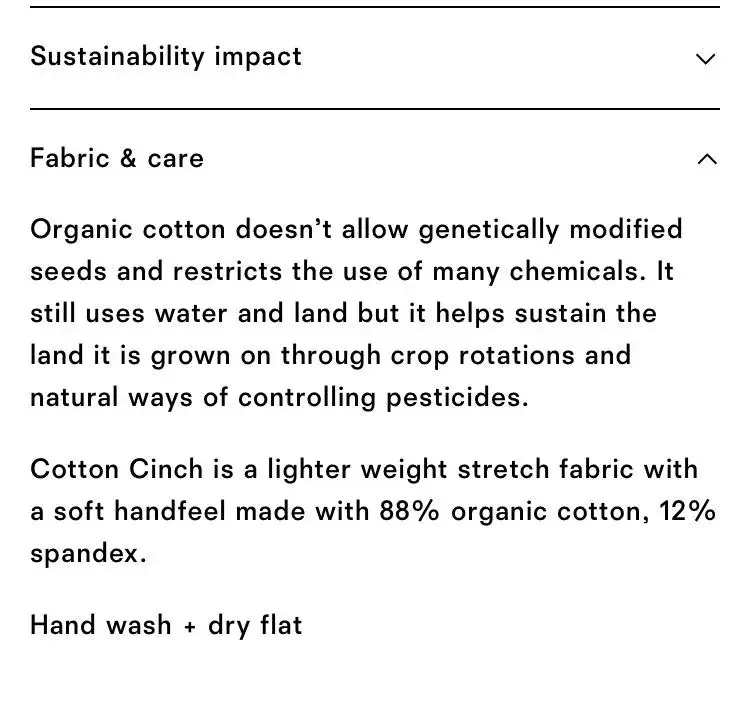
So, when I repeatedly encountered this:
"Organic cotton doesn’t allow genetically modified seeds and restricts the use of many chemicals. It still uses water and land but it helps sustain the land it is grown on through crop rotations and natural ways of controlling pesticides."
in the Fabric and Care section of their cotton clothing, it kept nagging at me.
What does this even mean? Did cotton wake up one morning and decide that it would no longer allow genetically modified seeds to grow? And while it was at it, decide to restrict the use of chemicals? Also, how does cotton naturally control pesticides (not pests!)?
Grammar aside, organic cotton doesn't make these decisions. Organic certification standards do. In the United States, the USDA's organic standards prohibit the use of genetically engineered seeds and restrict the use of most synthetic pesticides and fertilizers. Textile certification standards such as the Global Organic Textile Standard (GOTS) impose additional requirements on how organic fibers are processed into fabrics. Also, cotton can be grown in rotations that help maintain soil health, including rotations with and without legumes. However, the problem here is that the benefits arise from agricultural management practices, not from some inherent soil-restoring property of organic cotton. Diversification of crops grown through a rotation can also break pest and disease cycles.

Normally, I let broad, sweeping marketing statements slide; they have their own purpose. But in 2022, fresh into my tenure-track job as an assistant professor of plant biotechnology, I thought I could make a difference to a company I loved - with free advice! And so, I emailed their customer service team. I told them that the sentence was grammatically incorrect at best and misleading at worst. I even included a link to the USDA website explaining organic standards. And then, I apologized to them in case I was not helpful. I received a lovely response from customer service, promising to forward my wisdom to the appropriate teams.
And then… nothing happened.
Until 2026, when Reformation overhauled its website and changed its fabric descriptions. It now reads: "Organically grown cotton doesn’t allow genetically modified seeds and restricts the use of many chemicals. It still uses water and land but it helps sustain the land it is grown on through crop rotations and natural ways of controlling pests".
Slight improvement. But somehow, I doubt it has anything to do with an email from a plant biologist 4 years ago.
(2) “You think we don’t know the difference between indica and sativa?”
Of course, the only right answer to the question above is that in botanical nomenclature indica means “of India,” while sativa means cultivated (from the latin word sativus meaning ‘sown’ or ‘planted’).
Except at a cannabis store.
In 2016, my friend and I road-tripped to Seattle after attending a conference in Portland. On our last day, we walked into a legal cannabis shop in the Pike place market area. My friend was jet-lagged and wanted some gummies that would help him sleep during his bus trip to Southern California. It was my first time in a legal cannabis store, and we definitely needed help. We approached a very helpful shop associate and explained that we were looking for something that could help someone fall asleep.
“Do you know the difference between indica and sativa varieties?” he asked.
I had been waiting for this moment since the day I graduated with my B.Sc. Botany (Honors) degree.
I actually laughed. “You think we don't know the difference between indica and sativa varieties?! We are plant scien—”
I felt a very hard nudge from my friend. The universal sign for you should shut up now.
The associate looked at me, then at my friend, and patiently continued on to explain that indica strains supposedly help you relax, while sativa strains are considered more energizing.
Psychoactivity-based botanical classification was brand new information to me!
However, subject matter experts including authors of this 2021 study comparing 100 sativa and indica labelled samples, agree that commercially labelled sativa and indica cannabis samples are not genetically distinct in a way that reliably matched those labels. Nor did the labels consistently distinguish their cannabinoid profiles. Instead, the scientists saw a difference in Terpenoid content which could give them distinctive aromas but not reliable psychoactivity. In other words, the labels were better at describing differences in aroma-related chemistry than predicting whether a product would put you to sleep or keep you awake!
Cannabis taxonomy remains debated but some botanists argue that all cannabis strains belong to a single species, Cannabis sativa, rather than treating Cannabis indica and Cannabis sativa as separate species.
In summary, Marketing jargon:2. Plant Biology Degree:0.
Author’s note: This post was edited for grammar and flow with assistance from artificial intelligence (AI). All experiences, observations, and ideas are the author’s own.


Comments